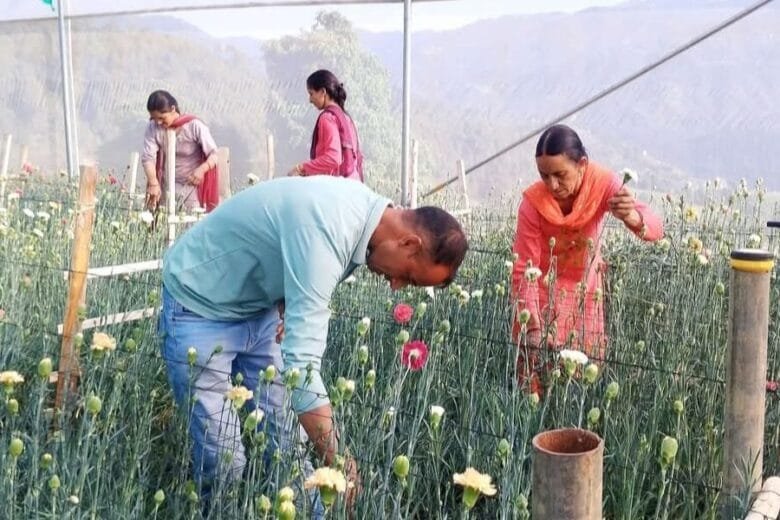
His success story is not isolated. In Mandi district, farmers like Ravinder Kumar have embraced floriculture, earning between ₹11-12 lakh annually by cultivating carnations in polyhouses. Government schemes like the Himachal Flower Revolution Scheme and the Integrated Horticulture Development Mission have played a pivotal role by providing subsidies up to 85% for polyhouse construction and other necessary infrastructure .The Tribune+4Apni Kheti+4CMV360+4Nursery Today+2The Tribune+2The Tribune+2
Similarly, in Hamirpur’s Karadi village, youths such as Vishal Singh and Karnail Singh transitioned from low-paying jobs to flower farming, now earning ₹5-6 lakh annually. They benefited from government subsidies on polyhouses and received training from the horticulture department, which has been instrumental in their success .
The Mehak Yojana initiative further exemplifies the state’s commitment to promoting floriculture. Under this scheme, farmers cultivating wild marigold receive subsidies up to 85%, with some earning ₹12,000 to ₹15,000 per liter of extracted oil. This has significantly boosted the income of farmers in regions like Padhar .himachalheadlines.com+2Nursery Today+2Organiser+2
These stories highlight a broader trend in Himachal Pradesh, where floriculture is emerging as a lucrative alternative to traditional farming. With government support, training, and access to modern farming techniques, many are finding renewed prosperity in flower cultivation.CMV360+1Nursery Today+1
Bhag Singh’s transformation from an IT job to a flourishing flower farming business serves as an inspiration, showcasing the potential of combining traditional agriculture with modern practices and support systems.