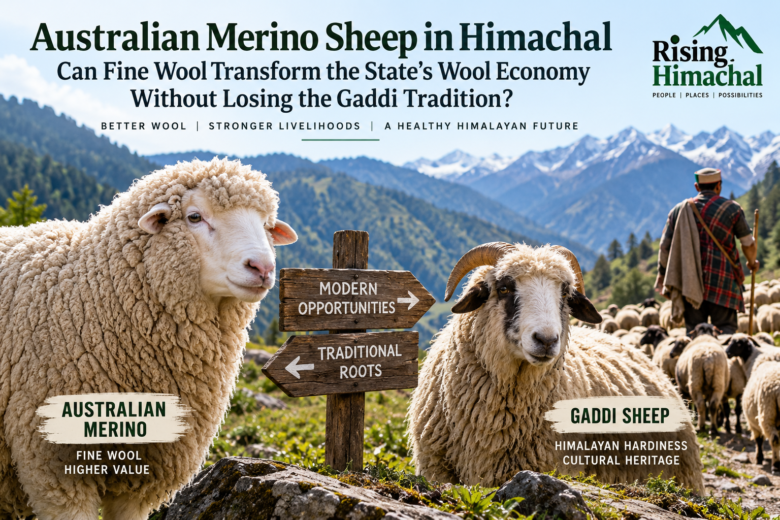
Australian Merino Sheep in Himachal: Can Fine Wool Transform the State’s Wool Economy Without Losing the Gaddi Tradition?
Shimla: Himachal Pradesh is taking a new approach to its traditional sheep and wool economy by introducing Australian Merino genetics into local sheep breeding programmes. The objective is straightforward — produce finer, higher-value wool and increase the income potential of sheep farmers and pastoral communities.
But behind this effort lies a much bigger question: Can Himachal modernise its wool industry while protecting the indigenous Gaddi sheep, traditional pastoral practices and the cultural knowledge associated with them?
Himachal’s push for better-quality wool
Himachal Pradesh has set an ambitious target of increasing its annual wool production to around 3,000 tonnes by 2027. The state currently produces approximately 1,500 tonnes of wool.
As part of the wool-development programme, Australian Merino sheep were introduced to Himachal for crossbreeding with indigenous sheep.
In 2021, 240 Merino sheep — 40 males and 200 females — were brought to the government sheep-breeding farm at Nagwain in Mandi district.
Merino sheep are internationally known for producing fine wool that is widely used in apparel and other high-value textile products.
The breeding programme aims to combine the fine-wool characteristics of Merino sheep with the hardiness and local adaptation of Himachal’s indigenous sheep.
From Gaddi wool to finer crossbred wool
One of the major differences between the two types of sheep is wool quality.
Indigenous Pahari or Gaddi sheep generally produce wool of around 27 microns, while the breeding programme aims to produce wool in the 21–22 micron range, which is considered finer and more suitable for apparel.
Artificial insemination has been used as part of the breeding programme.
According to the reported figures, the original Merino flock has produced around 800 healthy lambs through Merino-Gaddi crossbreeding. Some of these animals have subsequently been moved to areas associated with Gaddi pastoralists, including Bharmour in Chamba district.
The expectation is that local farmers and pastoralists will eventually be able to access these improved animals and benefit from better wool prices.
Why Merino sheep are attractive to the wool industry
The economics are an important part of the story.
Fine wool generally has greater commercial value than coarse wool. The source article reports that pastoralists may receive only around ₹12–15 per kg for locally produced wool from private traders, while crossbred wool can command approximately ₹40–70 per kg, depending on quality and market conditions.
For a sheep-rearing community facing rising costs and changing livelihoods, a significant increase in wool value could make sheep farming more financially attractive.
This is particularly important because the challenge facing Himachal’s pastoral communities is not simply wool production. It is also about maintaining a viable livelihood from traditional sheep rearing.
But Himachal is not Australia
This is where the Merino experiment becomes more complicated.
Australian Merino sheep have been developed within a very different livestock environment. Himachal’s sheep, particularly those associated with Gaddi pastoralism, have evolved alongside the Himalayan landscape.
Gaddi sheep are part of a traditional transhumant pastoral system, in which shepherds move their flocks between different elevations according to the seasons.
These animals can travel long distances through steep and rugged terrain and survive in changing climatic conditions.
Their adaptation is not simply a matter of breed genetics. Generations of pastoral knowledge have developed around them — including knowledge of grazing routes, vegetation, weather, animal health and seasonal migration.
Could finer wool create new challenges?
Fine wool may bring better prices, but it may not automatically mean better performance in Himachal’s mountains.
The local environment includes steep terrain, heavy monsoon rainfall, cold winters, dense vegetation and long seasonal migrations.
Concerns have been raised that softer and denser Merino-type wool could absorb more moisture during wet conditions and potentially increase problems related to skin infections and other diseases.
There are also questions about whether softer-hoofed crossbred animals will perform as well as indigenous sheep on steep and rocky Himalayan terrain.
These questions cannot be answered simply through laboratory breeding programmes.
They need to be tested in real village conditions and in the hands of the pastoralists who depend on these animals.
The bigger concern: What happens to the Gaddi sheep?
Perhaps the most important issue is not whether Merino crossbreeding can produce finer wool.
It is whether the drive for commercially valuable wool could gradually reduce the importance of the indigenous Gaddi breed.
If farmers receive substantially better prices for crossbred wool, they naturally have an economic reason to move towards crossbreeding.
Over time, widespread replacement of indigenous animals could mean losing more than a local sheep breed.
The Gaddi sheep is closely connected with Himachal’s pastoral culture, traditional wool products and seasonal movement across the mountains.
Traditional wool is used in products such as pattu, unali coats, carpets and other dense woollen materials.
These products represent a distinctive part of Himachal’s cultural and craft heritage.
The answer may not be to choose one breed over another
The debate should perhaps not be framed as Merino versus Gaddi.
There may be room for both.
Crossbreeding could provide farmers with access to higher-value wool while carefully maintaining pure indigenous Gaddi breeding lines.
At the same time, improving the quality, processing, branding and marketing of indigenous Gaddi wool could increase its value instead of treating it simply as a low-priced raw commodity.
Better collection systems, organised cooperatives, improved wool processing, direct access to markets and stronger branding of authentic Himachali wool products could potentially give pastoralists better returns without forcing them to abandon their traditional animals.
What Himachal needs to monitor
The success of the Merino programme should not be measured only by the number of lambs produced or the micron count of their wool.
It should also be measured by:
- Survival rates under actual Himalayan conditions
- Performance during monsoon and winter
- Disease resistance
- Ability to travel across steep terrain
- Wool yield and quality
- Income earned by farmers
- Market demand for the wool
- Impact on indigenous Gaddi sheep populations
- Effect on traditional pastoral practices
Most importantly, the experience of Gaddi shepherds should remain central to the programme.
They understand the mountains and their animals in ways that cannot be replicated by a breeding centre alone.
A balance between innovation and tradition
Himachal Pradesh has a genuine opportunity to strengthen its wool economy.
Australian Merino genetics could potentially help produce finer wool, improve market value and create better economic opportunities for sheep farmers.
But the state’s indigenous Gaddi sheep should not become collateral damage in the process.
The goal should be better incomes without losing local genetic diversity, traditional knowledge and pastoral culture.
Himachal’s future wool economy does not necessarily have to choose between modern breeding and traditional sheep rearing.
The real challenge is to find a model where innovation strengthens the livelihoods of pastoralists while the Gaddi sheep and the knowledge surrounding it continue to survive in the Himalayan landscape.
Because in Himachal, sheep are not merely livestock.
For generations of pastoral communities, they have been part of the mountain economy, culture, movement and way of life.
Source note for publication: The factual basis above is derived from the Down To Earth report published on August 29, 2026; the article has been independently structured and rewritten for RisingHimachal.com rather than reproduced.